Books, Web Recordings, CDs and Articles
|
It's Time For Online
Innovations In Annual Giving
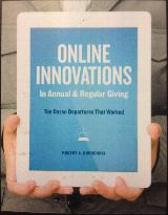
Bob's third CASE book - Online Innovations in Annual and Regular Giving: Ten Dozen Departures That Worked - features a whole mega-bunch of creative Web-based fundraising strategies from e-mail and video to crowd-funding and micro-philanthropy. The new book includes a pdf version with live links to sites, videos and more.
| |
Bob In CASE Currents:
Five Annual Giving Strategies For Today
Annual giving remains a foundation of the development program, but best practices are changing fast. Read Bob's quotes in CASE Currents about evolving strategies for annual giving.
See all of Bob's quotes in print.
| |
Fundraising Strategies From Around The World:
More Innovations In Annual Giving
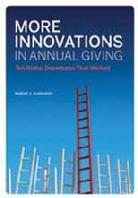
Bob's second CASE book - More Innovations in Annual Giving: Ten Global Departures That Worked - features creative annual giving strategies from institutions around the world, including Australia, India, Singapore, Hong Kong, France, the U.K. and beyond. Included are examples of data mining, leadership giving, reunions parent funds, faculty and staff appeals, the Internet, direct mail and more. Read more about the book and order from the CASE Books website.
| |
Annual Giving Vs. Giving Annually
Fundraising and Philanthropy Magazine Australia
August, 2007
Here is Bob's article from the August, 2007 issue of Fundraising and Philanthropy Magazine in Australia.
Download a pdf copy of the article
| |
|
Bob's Monthly E-Newsletter Archives
Review and download pdf past issues of Bob's monthly "Latest Departures" annual giving newsletter.
Click here to review past issues.
| |
Bob Burdenski Online Speaker Series Web Media and CD-Roms Available From CASE
Annual Giving Strategies to Reach and Raise Funds from International Alumni
(Pre-recorded webinar) On January 30, 2014, CASE Innovations in Annual Giving author and Crystal Apple speaker Bob Burdenski hosted a webinar full of ideas and strategies for engaging your overseas audiences in your annual and regular giving fundraising program. Overseas prospects were often excluded from annual giving appeals in the past, but in recent years they have become an accessible (and often affluent) fundraising audience. Join us for an around-the-world tour of new ideas for overseas audiences—Burdenski is well-known for featuring a lot of examples from a range of institutions in his presentations. During this Web recording, Bob will:
Discuss the latest new overseas annual giving fundraising ideas in social media, email, micro-philanthropy, crowdsourcing, video and others.
Discover smart overseas enhancements for traditional annual giving methods-strategies for phonathons, direct mail and personal solicitation.
Determine the role and use of volunteers in far-away places for annual giving.
Review considerations for presenting the annual giving case for support in a multilingual and multicultural world.
See more at the CASE Web site.
Online Annual Giving Success: On November 18, 2004, Bob hosted a CASE Online Speaker Series program that featured examples of online annual giving fundraising. Joining Bob were Lorna Lodholz, director of annual giving at North Carolina State University, Shawn Dailey, associate director of annual giving at Kenyon College, and Barbara Daines, associate director of alumni relations for the Stanford Business School Alumni Association. More than 200 schools, colleges and universities participated in the seminar - one of the largest CASE web seminars in their history. The audio and handouts from the seminar are available from CASE at their web site here. Innovations in Annual Giving: On April 14, 2004 Bob hosted a CASE Online Seminar that featured excerpts from the book Innovations in Annual Giving. His featured guests were Laurent DeJanvry from the University of California at Berkeley, and Mari Aylin from St. Olaf College, who both discussed alumni surveys they've used to understand annual giving behavior at their schools. More than 100 schools, colleges and universities participated in the seminar. The audio and handouts from the seminar are available from CASE at their web site here.
|
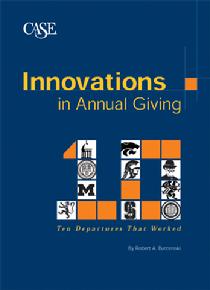
Innovations in
Annual Giving:
Ten Departures
That Worked
by Robert A. Burdenski
Published by the Council for the Advancement and Support of Education
Order It Here
|
|
WASHINGTON, D.C. -- Annual giving is the foundation of most successful fund-raising programs, yet many institutions don’t have a strategy in place for turning “interested bystanders” into “impassioned philanthropists” and instead rely on anecdote rather than data to make important decisions. A new book published by the Council for Advancement and Support of Education, Innovations in Annual Giving: Ten Departures that Worked, profiles 10 annual giving programs that consistently gain first-time donors, cultivate loyalty, and persuade existing donors to increase their gifts over time. Annual giving programs are institutions’ yearly solicitations of alumni and other friends and supporters. Aside from the total dollars raised during these appeals, the percent of alumni who donate is widely considered to be one measure of alumni loyalty. Annual giving has long been thought to be the first level of the “Donor Giving Pyramid” because it is the basis of other, larger gifts, Burdenski writes. However, the traditional pyramid overlooks the stages that annual donors go through on their way to becoming major donors. Burdenski has developed an “Annual Giving Pyramid” to express the steps through which annual donors progress: - Ongoing Institutional Affinity
- Learned Culture
- Initial Gift Support
- Sustained Giving Relationship
- Increased Donor Value
- Qualified Major Gift Prospects
| "Innovations in Annual Giving will provide those managing mature annual funds in the UK with a host of ideas and a broad focus to consider how they may wish to take their programmes forward."
Hamish Stewart
Head of the UCL Annual Fund
University College London
"The book was a quick read with lots of ideas to get us brainstorming. It made us realize that good programs do not happen overnight and that a long-range plan is needed, especially in bringing along our alumni giving participation."
Sue Bunning
University of Southern Indiana
USI Foundation
|
"...Bob Burdenski 'gets it'...his whip-smart book is framed by this sensibility and the great ideas inside will take you 'inside the looking glass' to applications in your own program."
Larry Lafferty
Director of Development, Annual Giving Programs & Special Campaigns
Ohio University
"A great mix of proven best practices and new, creative approaches to annual giving. Some excellent examples of new initiatives that have had a measurable impact on fund-raising results."
Maureen Coleman
Annual Fund Director
University of Rhode Island
|
"Besides the furor of new ideas it has generated, the book itself has become invaluable when approaching the many different academic units that we support and offering alternative options to the standard approaches."
Laura Lucas
Tim McLaughlin
Mizzou Annual Fund
University of Missouri
|
“An institution inspires feelings of affinity in its donors, teaches a philanthropic culture, and instills a progressively loyal and generous giving habit,” Burdenski writes. Burdenski focuses on annual giving programs at the Universities of Iowa, Rochester, Michigan, California at Berkeley, and Southern California; Kansas State, Stanford, and Carnegie Mellon Universities; Reed College; and Phillips Exeter Academy. The programs were chosen because they all have been successful and have characteristics that can be modeled by other institutions. Kansas State University’s program, even in this high-tech age, continues to rely on a yearly phonathon manned by hundreds of student volunteers. The program is legendary for the loyalty it has inspired: Most recently, the phonathon raised nearly $2 million from more than 20,000 alumni donors. “For institutions that face limitations on automation and other resources, or are simply looking for a good profitable time, the K-State program is a role model,” Burdenski writes. The University of Rochester, on the other hand, is an example of how annual giving programs can be integrated with the Internet, moving beyond simply providing a giving page on the university’s Web site to full-scale solicitation of many alumni via e-mail. “The Rochester Fund now sends e-mail messages that provide donors with periodic updates on how their gifts are being used. The kind of stewardship that used to be cost-prohibitive is now easily and inexpensively available via e-mail,” Burdenski writes. Innovations in Annual Giving is likely to help elevate the image of annual giving programs, writes Adrienne A. Rulnick, senior director of development and alumni relations at New York University, in the book’s foreword. “Bob reminds us that exemplary annual fund programs succeed in turning donors into philanthropists identified and primed for major gift cultivation. When these goals are achieved, annual giving attains a position of respect and influence within an institution, making a critical difference.”
|
|
 Bob's Original "Innovations" Book Becomes The First CASE Publication Ever Translated Into Chinese
 Published by CASE Books
 Published by CASE Books
 Bob Contributed An Annual Giving Chapter To The David Willows Book